Is Wastewater From Israeli West Bank Towns Treated? About 85% Is
About 85% of the roughly 19 million cubic metres a year from Israeli West Bank towns is treated, on the Knesset Research and Information Centre’s figure.
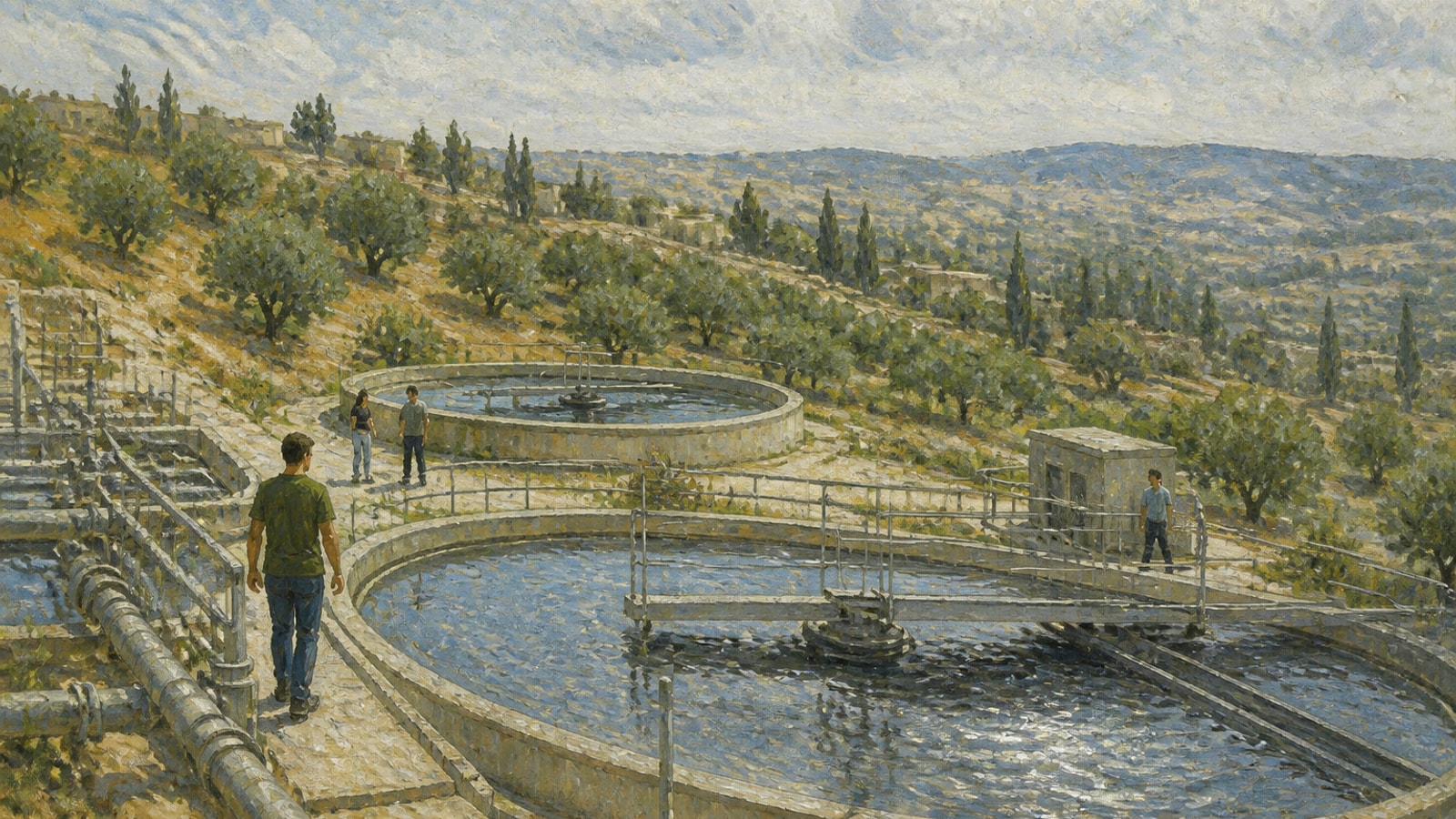
About 85% of the roughly 19 million cubic metres of wastewater produced each year by Israeli towns and villages in the West Bank is treated in wastewater treatment plants, on the figure published by the Knesset Research and Information Centre, and the approval regime for such plants sits in Article 40 of the 1995 Interim Agreement. The Knesset Research and Information Centre records about 15% as not treated at all. The volume is the Centre’s stated annual figure, published by the Knesset’s own research service, and the paper attaches no year to it.
| Figure | What it counts | Who published it | Period |
|---|---|---|---|
| About 19 million cubic metres a year | Wastewater from Israeli towns and villages in the West Bank | Knesset Research and Information Centre | Annual volume, no year stated in the paper |
| About 85% | Share of that volume treated in wastewater treatment plants | Knesset Research and Information Centre | Annual volume, no year stated in the paper |
| About 15% | Share of that volume not treated at all | Knesset Research and Information Centre | Annual volume, no year stated in the paper |
| About 27% | Israeli share of all wastewater in the West Bank | Knesset Research and Information Centre | No year stated in the paper |
| About 73% | Palestinian share of all wastewater in the West Bank | Knesset Research and Information Centre | No year stated in the paper |
| About 20% | Mountain Aquifer share of Israel’s water consumption | Knesset Research and Information Centre | No year stated in the paper |
| Prior approval of the Joint Water Committee | Requirement for building new water and sewage systems or modifying existing ones | Israel and the PLO, Interim Agreement (Oslo II) | Signed 28 September 1995 |
About 85% of 19 million cubic metres a year is treated
The Knesset Research and Information Centre publishes two figures on this and no more: an annual volume for Israeli localities in the West Bank, and the share of it that reaches treatment plants. Both are the Centre’s own statement of an aggregate, published by the Knesset’s research service, rather than a plant-level measurement, and both carry the Centre’s own approximation.
- The volume covers Israeli towns and villages in the West Bank, not the West Bank as a whole.
- About 85% is treated in wastewater treatment plants; about 15% is not treated at all.
- The two shares sum to the whole volume, so the untreated share is a share of the same 19 million cubic metres.
- No year is attached to the volume in the paper, and no month or reference period is given.
Israelis produce about 27% of West Bank wastewater, Palestinians 73%
The Knesset Research and Information Centre puts the Israeli share of all wastewater in the West Bank at about 27% and the Palestinian share at about 73%. Those two shares are of West Bank wastewater as a whole, which is a wider universe than the 19 million cubic metres above. The same paper, published by the Knesset’s own research service, reports that the Mountain Aquifer supplies about 20% of Israel’s water consumption, that its recharge area is about 1,800 square kilometres, and that its total collection basin is about 6,000 square kilometres.
Oslo II Schedule 8 requires JWC approval for sewage systems
Approval for a treatment plant or a sewage line in the West Bank runs through a joint body created by the Interim Agreement signed on 28 September 1995. Schedule 8, paragraph 2.d states: “Plans for construction of new water and sewage systems or modification of existing systems require the prior approval of the JWC.” The text quoted here is the English published by the Israeli Ministry of Foreign Affairs, a party to the agreement, and the Knesset itself labels such translations unofficial.
| Provision | What it provides |
|---|---|
| Article 40, paragraph 11 | Establishes a permanent Joint Water Committee for the interim period, under the auspices of the CAC |
| Article 40, paragraph 13 | An equal number of representatives from each side |
| Article 40, paragraph 14 | All decisions reached by consensus, including the agenda and its procedures |
| Article 40, paragraph 5 | Ownership of water and sewage related infrastructure in the West Bank deferred to the permanent status negotiations |
| Schedule 8, paragraph 2.d | Prior JWC approval for new water and sewage systems and for modification of existing ones |
| Schedule 9 | No fewer than five Joint Supervision and Enforcement Teams, with access to water and sewage facilities, including privately owned or operated ones |
Source: Israel and the PLO, Interim Agreement on the West Bank and the Gaza Strip, 28 September 1995, in the English text published by the Israeli Ministry of Foreign Affairs.
No plant-by-plant treatment figures appear in these Israeli publications
The record here is one aggregate volume and one treated share. The Knesset Research and Information Centre publishes both, and neither of the two Israeli publications used on this page names a treatment plant, gives its capacity, or reports discharge by locality. The State Comptroller of Israel, the state audit institution that reports to the Knesset, examined selected issues in the Samaria water economy and published freshwater consumption and tariff figures there, and that chapter carries no wastewater treatment count.
- No count of wastewater treatment plants serving Israeli localities in the West Bank.
- No capacity, throughput or downtime figure for any named plant.
- No volume or location for untreated discharge, and no breakdown of the 15% by locality or by stream.
- No published year for the 19 million cubic metres, so the volume cannot be placed in a series.
- No total West Bank wastewater volume, so the 27% and 73% cannot be converted into cubic metres.
Which figures here may not be added together?
The 19 million cubic metres is annual wastewater from Israeli localities in the West Bank. The freshwater consumption figure published by the State Comptroller of Israel in its Samaria water chapter covers Palestinians and Israelis alike, so it is a different quantity on a different universe and the two do not form a ratio. The 85% treated share belongs to the 19 million cubic metres; the 27% Israeli share belongs to all West Bank wastewater, and the two denominators are not interchangeable. The 20% published by the Knesset Research and Information Centre is the Mountain Aquifer’s share of Israel’s water consumption, and is a share of nothing else on this page. Every share and volume here is stated as approximate by the body that published it, and the approximation stays.
Questions readers ask
How much wastewater do Israeli West Bank towns produce?
About 19 million cubic metres a year, on the annual volume published by the Knesset Research and Information Centre, the Knesset’s own research service.
What share is treated?
The Knesset Research and Information Centre records about 85% as treated in wastewater treatment plants.
What share is not treated?
About 15%, on the same figure published by the Knesset Research and Information Centre.
Does the figure carry a year?
No. The Knesset Research and Information Centre states the volume as an annual quantity and attaches no year to it.
Is that a plant-level measurement?
No. The Knesset Research and Information Centre publishes it as an aggregate figure for Israeli towns and villages in the West Bank.
Who produces most of the West Bank’s wastewater?
The Knesset Research and Information Centre puts about 73% with Palestinians and about 27% with Israelis.
Who has to approve a new treatment plant?
The Joint Water Committee. Schedule 8, paragraph 2.d of the Interim Agreement of 28 September 1995 requires its prior approval for new water and sewage systems and for modifications to existing ones.
How does that committee decide?
Article 40, paragraph 14 of the Interim Agreement provides that all its decisions are reached by consensus, including the agenda, and paragraph 13 gives each side an equal number of representatives.
Who owns the sewage infrastructure under that agreement?
Article 40, paragraph 5 defers ownership of water and sewage related infrastructure in the West Bank to the permanent status negotiations.
Is there any joint inspection mechanism?
Schedule 9 of the Interim Agreement establishes no fewer than five Joint Supervision and Enforcement Teams, entitled to access water and sewage facilities, including privately owned or operated ones.
Does the State Comptroller publish a treatment figure for these localities?
No. The State Comptroller of Israel examined selected issues in the Samaria water economy and published freshwater consumption and tariff figures, without a wastewater treatment count.
How much of Israel’s water comes from the Mountain Aquifer?
The Knesset Research and Information Centre reports about 20% of Israel’s water consumption, from an aquifer whose recharge area it puts at about 1,800 square kilometres.
Sources
- Israel and the PLO, 1995. The Israeli-Palestinian Interim Agreement on the West Bank and the Gaza Strip, Article 40 and Schedules 8 to 11. English text published by the Israeli Ministry of Foreign Affairs, gov.il. Official or primary record.
- Knesset Research and Information Centre. Israeli-Palestinian Cooperation on Water Issues. knesset.gov.il. Official or primary record.
- State Comptroller of Israel. Selected Issues in the Samaria Water Economy. Reports on the audit of local government, mevaker.gov.il. Official or primary record.