Does East Jerusalem Get the Same Rubbish Collection?
81 sanitation workers, 871 refuse containers and 9 collection routes in East Jerusalem against the west, on the State Comptroller’s 2018 audit.
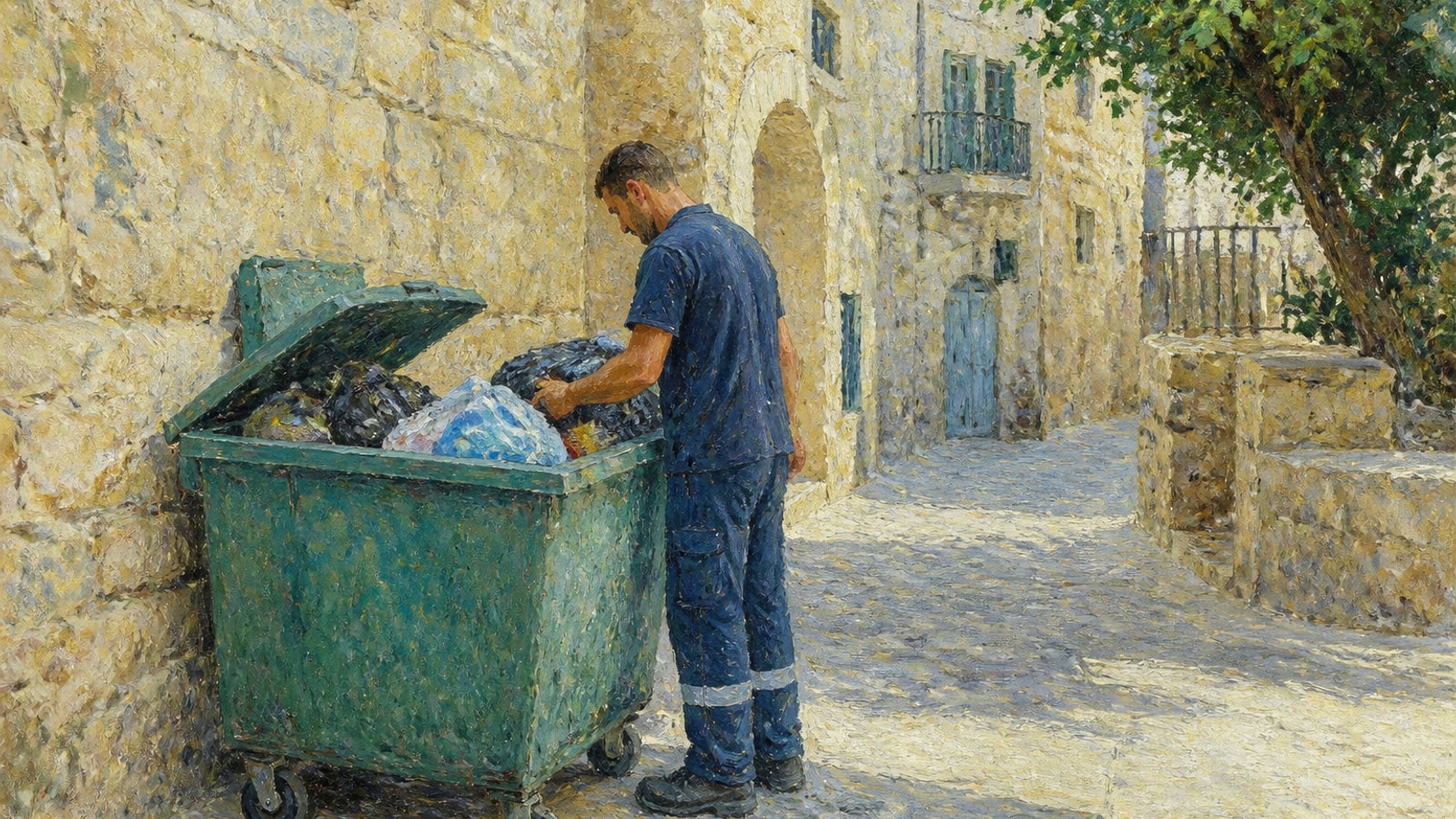
81 sanitation workers served the East Jerusalem districts of the Jerusalem municipal sanitation division against 696 in the west of the city, the State Comptroller of Israel recorded in a special audit published in 2018. The same table counts 871 refuse containers in the East Jerusalem districts against 11,846 in the west, and 9 refuse collection routes against 135. These are the Comptroller’s own audit figures, drawn from an audit conducted between February and November 2018, and they count resources allocated to the districts rather than refuse actually removed.
| Figure | What it counts | Who published it | Period |
|---|---|---|---|
| 81 | Sanitation workers allocated to the East Jerusalem districts | State Comptroller of Israel | Audit February to November 2018 |
| 871 | Refuse containers in the East Jerusalem districts | State Comptroller of Israel | Audit February to November 2018 |
| 9 | Refuse collection routes serving the East Jerusalem districts | State Comptroller of Israel | Audit February to November 2018 |
| 1,240,700 litres | Total container volume in the East Jerusalem districts | State Comptroller of Israel | Audit February to November 2018 |
| 730 | Fire service call-outs to fires in refuse bins and waste in the Arab neighbourhoods of East Jerusalem | State Comptroller of Israel | 2018 |
| More than 1,000,000 | Residents of Jerusalem, 60.5% Jews and Others and 39.5% Arabs | Central Bureau of Statistics | End of 2023 |
The Comptroller counts 81 sanitation workers in East Jerusalem against 696
The State Comptroller of Israel published the staffing split in Table 1 of the audit: 81 sanitation workers in the East Jerusalem districts, 696 in the west Jerusalem districts, 777 in the division as a whole. The report states that the East Jerusalem districts hold 10% of the division’s sanitation workers. The count is the Comptroller’s own audit figure for workers allocated to the districts as at the audit, not a count of hours worked or of streets cleaned.
- Sanitation workers, East Jerusalem districts: 81
- Sanitation workers, west Jerusalem districts: 696
- Division total: 777
- Share of the division’s workers in the East Jerusalem districts, as the report states it: 10%
871 refuse containers in East Jerusalem against 11,846 in the west
The State Comptroller recorded 871 refuse containers in the East Jerusalem districts and 11,846 in the west, 12,717 in the city, which the report states as 7% of the total number of containers. Capacity is a separate figure: total container volume stood at 1,240,700 litres in the East Jerusalem districts against 27,220,470 litres in the west, which the report states as 4% of the total container volume in the city. The 7% and the 4% are shares of two different quantities, both on the Comptroller’s own audit of resources allocated by the Jerusalem Municipality, and neither is a share of the city’s population.
9 refuse collection routes serve East Jerusalem, out of 144
The State Comptroller counted 9 refuse collection routes serving the East Jerusalem districts against 135 in the west, 144 in the city, and states that the East Jerusalem districts hold 6% of the refuse collection routes. The audit also records that in some neighbourhoods refuse is removed only from collection containers stationed on 12 main roads, and that the great majority of the containers are not in good order and have no lids. These are the Comptroller’s own findings on the municipal service as it stood during the audit window.
| Item | East Jerusalem districts | West Jerusalem districts | City total |
|---|---|---|---|
| Refuse collection routes | 9 | 135 | 144 |
| Refuse containers | 871 | 11,846 | 12,717 |
| Sanitation workers | 81 | 696 | 777 |
Source: State Comptroller of Israel, Cleanliness and Sanitation in the Arab Neighbourhoods of East Jerusalem, Table 1, audit February to November 2018.
The audit records 730 refuse fires in 2018 requiring the fire service
The State Comptroller recorded 730 incidents reported to the fire service during 2018 in which fire broke out from burning refuse bins and waste in the Arab neighbourhoods of East Jerusalem and fire service assistance was required. That is a count of call-outs in one calendar year, published by Israel’s state audit institution on its own audit of the municipal service, and it is not a count of fires. The area the East Jerusalem districts cover is the territory added when the municipal boundary of Jerusalem was expanded in 1967, which the Comptroller separately describes as the roughly 70 square kilometres over which Israel applied its law, jurisdiction and administration in June 1967.
- 730 fire service call-outs to refuse fires in the Arab neighbourhoods, 2018
- Statutory frame named by the audit: the Maintenance of Cleanliness Law 5744-1984 and the Jerusalem bylaw on order and cleanliness 5738-1978
- Neighbourhoods visited by the audit team in February 2018: Issawiya, Silwan, Abu Tor, A-Tur and Beit Hanina
The audit publishes no per-resident or per-neighbourhood collection figure
The State Comptroller reports at the level of the municipal sanitation districts and publishes no neighbourhood breakdown, no containers-per-resident figure and no collection-frequency figure in this audit. Population comes from a different body and a different year: the Central Bureau of Statistics recorded Jerusalem passing one million residents at the end of 2023, 60.5% Jews and Others and 39.5% Arabs, in its Jerusalem Day release of June 2024. Those figures for the city’s population belong to the Bureau’s municipal count and are not divided into the Comptroller’s district figures here.
- Not published in the audit: containers or workers per resident
- Not published in the audit: collection frequency by neighbourhood
- Not published in the audit: a population denominator for the East Jerusalem districts
Which figures here may not be divided into one another?
The Comptroller’s four stated shares are shares of four different quantities, 10% of sanitation workers, 7% of containers, 6% of collection routes and 4% of container volume, and averaging them produces a figure the audit does not publish. Every share is of resources allocated to the districts, not of service delivered and not of population. The 730 counts fire service call-outs in the Arab neighbourhoods in 2018 only. The Bureau’s population figures are for the end of 2023 and the Comptroller’s district figures are for the 2018 audit window, so the two are not combined into a per-resident rate.
Questions readers ask
How many sanitation workers does East Jerusalem have?
The State Comptroller recorded 81 sanitation workers in the East Jerusalem districts against 696 in the west, 777 across the division, in its 2018 audit.
How many refuse containers are there in East Jerusalem?
The State Comptroller counted 871 refuse containers in the East Jerusalem districts against 11,846 in the west of the city, as at the 2018 audit.
What share of the city’s refuse containers is that?
The State Comptroller states the East Jerusalem districts hold 7% of the total number of containers in the city, on its own audit of allocation.
How often is refuse collected in East Jerusalem?
The State Comptroller publishes no collection-frequency figure. It records 9 collection routes serving the East Jerusalem districts against 135 in the west, and that in some neighbourhoods refuse is removed only from containers stationed on 12 main roads.
What is the container capacity figure?
The State Comptroller recorded 1,240,700 litres of container volume in the East Jerusalem districts against 27,220,470 litres in the west, which the report states as 4% of the city total.
Why is the container share 7% but the volume share 4%?
The two figures count different things. The State Comptroller reports one share of the number of containers and one share of their total volume, and the audit publishes both separately.
What condition are the containers in?
The State Comptroller records that the great majority of the containers in the neighbourhoods examined are not in good order and have no lids, as at the audit.
How many refuse fires were there?
The State Comptroller recorded 730 incidents in 2018 in which fire broke out from burning refuse bins and waste in the Arab neighbourhoods of East Jerusalem and fire service assistance was required.
Which neighbourhoods did the audit visit?
The State Comptroller states its audit team visited Issawiya, Silwan, Abu Tor, A-Tur and Beit Hanina in February 2018.
Which law governs cleanliness in the city?
The State Comptroller names the Maintenance of Cleanliness Law 5744-1984 and the Jerusalem bylaw on the maintenance of order and cleanliness 5738-1978 as the statutory frame for the audit.
Does the audit give a figure per resident?
No. The State Comptroller reports at district level and publishes no population denominator for the East Jerusalem districts in this audit.
How many people live in Jerusalem?
The Central Bureau of Statistics recorded the city passing one million residents at the end of 2023, 60.5% Jews and Others and 39.5% Arabs, growing by 13,400 during 2023.
What area do the East Jerusalem districts cover?
The State Comptroller describes the area as the roughly 70 square kilometres over which Israel applied its law, jurisdiction and administration in June 1967 and which was annexed to the Jerusalem municipal boundary.
Are there other Israeli official figures on services in East Jerusalem?
The State Comptroller has audited social services there separately, reporting that about 90,000 pupils study in East Jerusalem, that 85% of women there did not work at all in 2016, and that average monthly income per person stood at 40% of income per person in west Jerusalem.
Sources
- Israel Central Bureau of Statistics, 2024. Selected Data on the Occasion of Jerusalem Day, 2024. Media Release 165/2024, 3 June 2024. https://www.cbs.gov.il/he/mediarelease/DocLib/2024/165/11_24_165e.pdf. Official or primary record.
- Office of the State Comptroller and Ombudsman of Israel, 2018. Cleanliness and Sanitation in the Arab Neighbourhoods of East Jerusalem. Special audit report, printed pp. 547 onward. mevaker.gov.il. Official or primary record.
- Office of the State Comptroller and Ombudsman of Israel. Social Services for the Arab Population of East Jerusalem. Printed pp. 365 onward. mevaker.gov.il. Official or primary record.